Understanding Your Skin Barrier: A Complete Guide to Healthy, Resilient Skin
Have you ever switched cleansers, tried a new active, or simply gone through a stretch of cold weather, and suddenly your skin, calm and comfortable for months, starts stinging, tightening, or breaking out for no obvious reason? That frustrating and unpredictable shift is typically attributed to one factor: your skin barrier.
“Skin barrier” has become one of those phrases everyone in skincare throws around. It shows up on product labels, in serum descriptions, and across social media, often with little explanation of what it actually means or why it matters. That vagueness is a problem, because your skin barrier isn’t a marketing concept. It’s a real, well-studied biological structure, made of specific cells, lipids, and biochemical systems that all have to work together, and understanding how it actually functions changes how you think about nearly every other skincare decision you make, from the cleanser you reach for each morning to why your skin reacts so differently in January than it does in July.
The good news is that once you understand what your skin barrier is actually made of, how it protects you day to day, and what quietly wears it down, a lot of confusing or contradictory skincare advice starts to make sense. You’ll be able to tell the difference between a product that genuinely helps your skin function better and one that just makes it feel temporarily softer. You’ll understand why the same routine can work beautifully for months and then suddenly stop and why “more product” is so often the wrong answer when skin starts acting up.
In this guide, we’re breaking down exactly what your skin barrier is, what it’s made of, how it protects you, what tends to damage it, and what genuinely helps it recover. No vague buzzwords, just the actual science behind the structure that stands between your skin and everything it’s exposed to every day.
Let’s begin with the basics: what is your skin barrier?


What Is the Skin Barrier, Exactly?
When people talk about their “skin barrier,” they’re usually picturing something simple: a wall that either holds moisture in or lets it escape. In reality, your skin barrier is a far more sophisticated piece of biological engineering, and understanding how it actually works is the first step to caring for it properly.
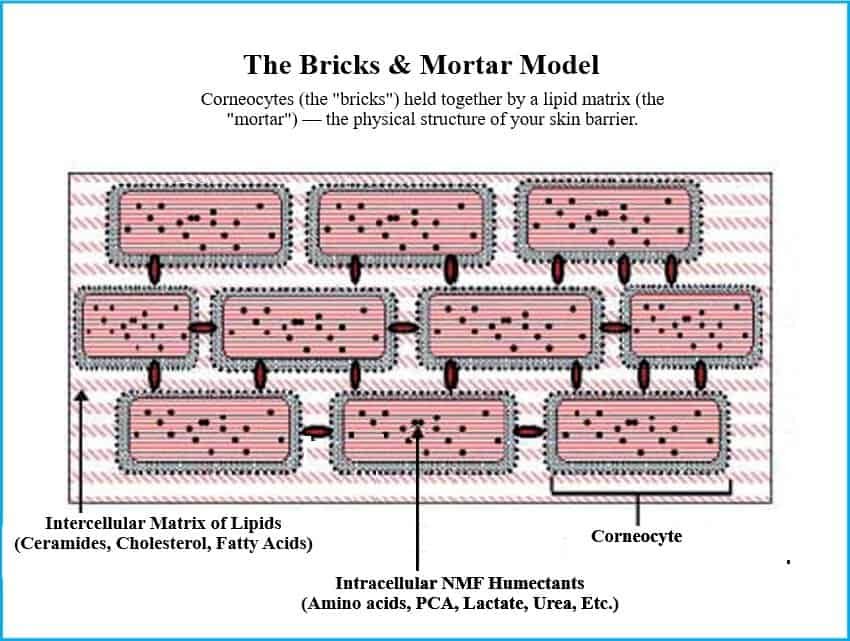
Your skin barrier lives in the outermost layer of your epidermis, called the stratum corneum. It’s often described using the “bricks and mortar” model: the “bricks” are corneocytes, flattened, keratin-rich skin cells that have completed their journey from the deeper layers of the epidermis. The “mortar” is a matrix of lipids, primarily ceramides, cholesterol, and fatty acids, that fills the spaces between those cells. Together, this brick-and-mortar structure forms a continuous, cohesive sheet that is remarkably effective at its job.
But here’s what most skincare conversations leave out: the skin barrier isn’t just one barrier. It’s actually a system of interdependent defenses, sometimes described as four “sub-barriers” working in sync:
- The physical barrier – the stratum corneum itself, providing structural cohesion and regulating water movement
- The biochemical barrier – surface lipids, your Natural Moisturizing Factor (NMF), and the skin’s acid mantle, which we’ll dig into shortly
- The immunological barrier – immune cells stationed throughout the skin that detect and respond to threats
- The microbiological barrier – your skin’s resident microorganisms, which help crowd out harmful invaders
Each of these plays a distinct role, yet they’re constantly communicating with one another. When one is disrupted, the others are often affected too.
Most people equate a “healthy skin barrier” with hydration alone, but its responsibilities go well beyond preventing transepidermal water loss (TEWL), the technical term for water evaporating from your skin’s surface. A properly functioning barrier also protects against ultraviolet exposure, buffers oxidative stress from environmental pollutants, and forms your skin’s first line of immune defense against bacteria, allergens, and irritants.
In other words, your skin barrier isn’t a passive wall. It’s an active, adaptive system, and every layer of your skincare routine either supports that system or works against it. With that structure in mind, we can now examine the three pillars of a healthy skin barrier that keep this system functioning daily.
The 3 Pillars of a Healthy Skin Barrier
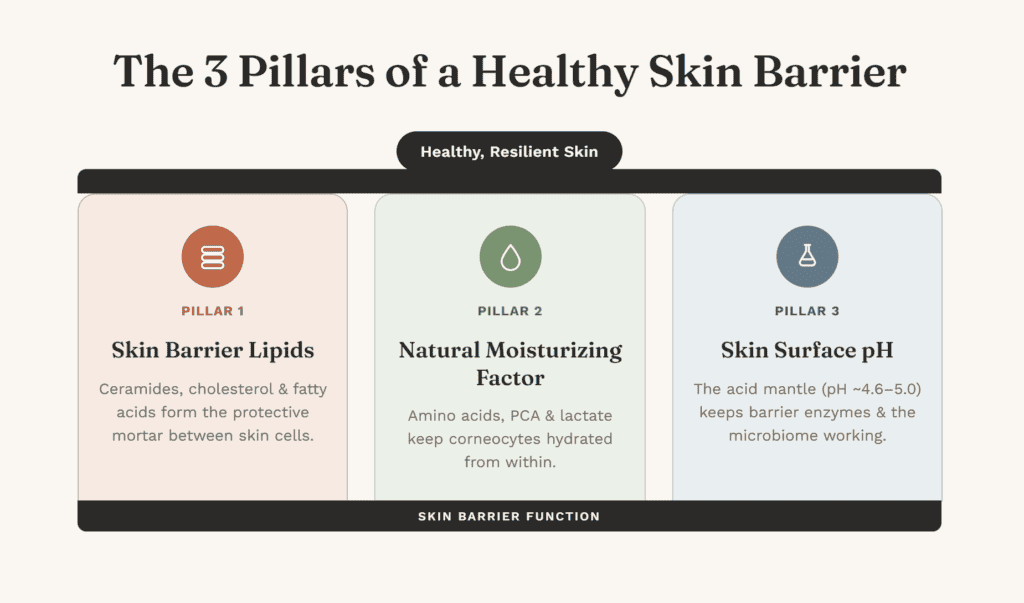
If the stratum corneum is the physical structure of your skin barrier, three biochemical systems are what actually keep that structure functioning: its lipids, its natural moisturizing factor, and its surface pH. Skincare formulators obsess over these three pillars for good reason. When all three are in balance, skin looks plump, smooth, and calm. When even one falls out of balance, the others tend to follow.
Pillar 1: Skin Barrier Lipids — The Mortar Holding It All Together
Remember the ‘bricks and mortar’ model? The mortar is made up mostly of three types of lipids sitting between your skin cells: ceramides (roughly 40–50% of this lipid mix), cholesterol (about 25%), and free fatty acids (10–15%), with the small remainder made up of minor lipid species, like residual cholesterol sulfate, that round out the mix. These lipids don’t just sit there passively. They arrange themselves into precisely stacked layers, or lamellae, that create a structured, water-resistant barrier between corneocytes.
The tighter and more orderly this lipid arrangement, the better your skin holds onto water and keeps irritants out. Two things can undermine it. First, the quality of the lipids: research shows that in dry or compromised skin, ceramides and fatty acids often shift toward shorter chain lengths, which pack together less densely and leave more gaps for water to escape through. Second, the sheer quantity of lipids: skin simply produces fewer of them as we age, and production drops further in the winter, when cold air holds less moisture and strips lipids from the skin’s surface faster. Whether it’s the quality of the lipids or the quantity, the outcome is the same: a weaker mortar between skin cells, more water loss, and the rough, dull, flaky texture that shows up most often in aging or winter skin.
Pillar 2: Natural Moisturizing Factor (NMF) — Your Skin’s Built-In Humectant
While lipids work on the outside of your skin cells, NMF works on the inside. NMF is a blend of naturally occurring, water-attracting compounds, mostly free amino acids, along with PCA, urocanic acid, lactate, and urea, that live inside your corneocytes. It’s formed when a protein called filaggrin breaks down as skin cells mature and move toward the surface.
This humectant cocktail is remarkably efficient. It can pull moisture from the surrounding air even in relatively low humidity, keeping corneocytes hydrated, flexible, and able to shed normally. When NMF levels drop, whether from harsh cleansing, low humidity, UV exposure, or simply aging, skin loses that internal water-binding capacity. Corneocytes become dry and rigid, shedding unevenly instead of individually, which shows up as visible flaking, roughness, and a loss of that supple, bouncy feel healthy skin has.
Pillar 3: Skin Surface pH — The Acid Mantle
The third pillar is one most people never think about: your skin’s surface pH. Healthy skin sits at a mildly acidic pH of around 4.6 to 5.0, often called the “acid mantle”, even though the living tissue just beneath it is closer to neutral (about 7.4). That steep pH gradient, occurring over a distance of just 15 to 20 micrometres, isn’t an accident. It’s essential to how your skin functions.
This acidity does three important jobs at once: it activates the enzymes responsible for producing ceramides and processing lipids into that protective mortar; it regulates the enzymes involved in shedding dead skin cells evenly; and it helps maintain a healthy skin microbiome by favouring beneficial bacteria like Staphylococcus epidermidis while making it harder for problematic species like Staphylococcus aureus to take hold. When skin pH rises, whether from harsh, alkaline cleansers, ageing, or environmental stress, all three of these processes become less efficient, and the barrier becomes more vulnerable.
Why These Three Pillars Work as a System
None of these three pillars functions in isolation. Lipid production is pH-dependent. NMF formation affects how corneocytes swell and shed. Surface pH shapes which microbes thrive on your skin, which in turn influences inflammation and barrier repair. This is why a skincare routine that only addresses one piece, say, slathering on a heavy moisturizer while ignoring a too-harsh cleanser, often falls short. A truly effective approach supports all three pillars together.
How Your Skin Repairs Itself
Your skin barrier doesn’t just sit there waiting to be damaged; it constantly monitors and self-corrects, often before you even notice a problem.
Here’s roughly how that process unfolds. The moment your skin barrier is disrupted, whether from a hot shower, a harsh cleanser, or a cold, windy day, water loss through the skin (TEWL) increases almost immediately. Your skin detects this shift within minutes and responds in stages:
- Immediate response (minutes): Lipids already stored and ready to go, held in structures called lamellar bodies just beneath the surface, are released into the stratum corneum. This alone can recover about 20% of lost barrier function almost right away.
- Short-term response (a few hours): Your skin ramps up production of new lipid precursors, which are then converted into ceramides, cholesterol, and fatty acids to rebuild the intercellular “mortar” more fully. This process is also when filaggrin breakdown accelerates, replenishing NMF levels inside corneocytes.
- Inflammatory response (as needed): If water loss climbs high enough, your skin releases signalling molecules that trigger mild inflammation and speed up cell turnover, essentially thickening the outer layer faster to reduce further water loss.
Under normal circumstances, this system works quietly and efficiently in the background, which is exactly why healthy skin can shrug off an occasional harsh cleanser or a dry, windy afternoon without any lasting effects.
The trouble starts when the damage is repetitive, prolonged, or simply too much for these self-repair mechanisms to keep up with. Daily overwashing, back-to-back use of strong actives, or a long stretch of low humidity can all outpace your skin’s ability to recover between insults. When that happens, your skin barrier tips from “self-repairing” into what researchers call an “overstressed” state, and that’s when visible problems start to appear. Now let’s take a closer look at a compromised skin barrier.
What a Compromised Skin Barrier Looks Like

What does it look like when your skin’s self-repair system struggles to keep up? The signs tend to appear gradually, and while each one may be easily dismissed, together they create a clear picture:
- Persistent tightness, especially right after cleansing
- Rough or flaky texture, even in areas that don’t feel visibly “dry”
- Dullness or an uneven skin tone
- Increased sensitivity, stinging, or reactivity to products that never used to bother you
- Redness or a generally irritated appearance
- Breakouts that seem to appear unexpectedly occur when a weakened barrier struggles to keep irritants and bacteria out.
Researchers describe this tipping point as an “overstressed” stratum corneum: the point where ongoing damage outpaces the skin’s ability to repair itself. Left unaddressed, this condition can spiral into what’s sometimes called the dry skin cycle. Barrier damage triggers a mild inflammatory response, which speeds up cell turnover to compensate. However, the accelerated turnover results in smaller, less mature skin cells that are less effective at forming a strong barrier, leading to increased water loss and inflammation, which perpetuates the cycle.
It’s worth noting that a compromised barrier isn’t just a cosmetic inconvenience. The same barrier dysfunction described here is also a hallmark of several common skin conditions, including atopic dermatitis, rosacea, psoriasis, acne, and xerosis (chronic dry skin). That doesn’t mean everyone with occasional dry patches has one of these conditions. It simply means the same underlying mechanism, a stressed, under-repaired barrier, sits at the center of many skin concerns people usually treat as separate problems. The good news is that in most everyday cases, a compromised barrier is reversible. Once you understand what is damaging your skin barrier and what it needs to recover, you can take appropriate action. Let’s talk about that.
What Damages the Skin Barrier
Barrier damage generally comes from two directions: things happening to your skin from the outside and things happening inside your body that make the barrier inherently more fragile. Most people manage a mix of both.
Exogenous Factors
These are environmental and lifestyle factors you have direct control over, which is good news, since it means barrier damage from this category is often the most preventable:
- Overwashing or long, hot showers – strips away surface lipids faster than skin can replace them
- Poorly formulated cleansers and soaps – harsh surfactants and highly alkaline formulas disrupt the acid mantle and strip barrier lipids. This situation isn’t a blanket case against true soap, though: a well-formulated, superfatted soap (one with extra unreacted oils left in during saponification) can be perfectly fine for many skin types.
- Over-exfoliation – frequent use of physical scrubs, high-strength acids, or daily retinoid use without adjustment can outpace the skin’s repair capacity.
- Low humidity and cold, dry climates – accelerate water loss and lipid depletion, which is why barrier issues spike in winter
- Pollution and environmental stressors – (like vehicle exhaust, cigarette smoke, and UV exposure) – contribute to oxidative stress and disrupt the skin’s microbial balance
- Aggressive actives used without care – ingredients like retinoids, benzoyl peroxide, and AHAs are effective but can compromise the barrier if introduced too quickly or layered carelessly
Endogenous Factors
These are factors rooted in your biology. You can’t change them, but understanding them helps explain why some people are simply more barrier-sensitive than others and why extra care matters more for some skin types:
- Genetics, including filaggrin gene mutations – some people naturally produce less filaggrin, meaning lower baseline NMF levels and a higher predisposition to dry, reactive skin
- Age – lipid synthesis and NMF production both decline over time, and skin’s buffering capacity for pH weakens as well.
- Ethnicity – research shows that darker skin types tend to have a more acidic surface pH and denser lipid content, which is associated with faster barrier recovery, while lighter skin types often show a higher baseline pH and slower recovery
- Underlying skin conditions – atopic dermatitis, psoriasis, and rosacea all involve inherent barrier abnormalities that make the skin more vulnerable to the exogenous factors above.
The encouraging part is that even when endogenous factors stack the odds against you, most exogenous damage is fully within your control, which brings us to what you can actually do about it.
How to Support and Repair Your Skin Barrier
Once you understand the three pillars and what tends to disrupt them, the actual strategy for supporting your skin barrier becomes fairly straightforward: reduce unnecessary damage and give your skin the raw materials it needs to rebuild.
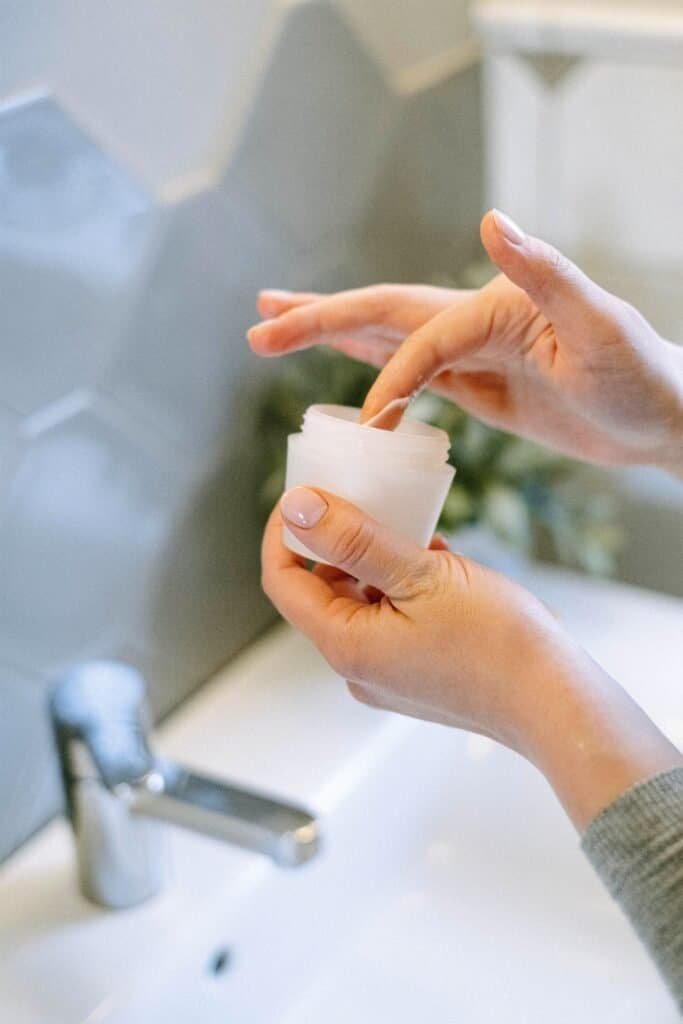

Start With Gentle, pH-Balanced Cleansing
Since cleansing happens daily and is one of the biggest levers you control, it’s worth getting right. Look for cleansers formulated close to the skin’s natural pH (roughly 4.5 to 5.5) rather than highly alkaline formulas; naturally derived, mild surfactants like coco glucoside or decyl glucoside can be formulated into cleansers that land in this range. Mild, low-irritation surfactant systems clean effectively without stripping the lipid matrix, and shorter, lukewarm (rather than hot) showers or washes reduce unnecessary lipid loss. This doesn’t rule out true soap: a well-formulated, superfatted bar can still be gentle on the barrier even at a higher pH, thanks to its lower free-alkali content and cushioning fatty acids. But if minimizing pH disruption specifically is your priority, a pH-balanced, naturally derived cleanser gets you there more reliably.
Choose Moisturizers That Rebuild, Not Just Coat
Not all moisturizing ingredients do the same job, and an effective barrier-support routine typically draws from a few different categories:
- Humectants (glycerin, urea, PCA, lactic acid, D-panthenol, hyaluronic acid) attract and hold water in the stratum corneum, mimicking the role of your own NMF.
- Physiological lipids (ceramides, cholesterol, and fatty acids) directly replenish the intercellular “mortar” rather than simply sitting on the surface.
- Occlusives (plant oils, butters, and waxes) slow water loss by forming a protective layer on top of the skin.
A well-formulated moisturizer usually combines ingredients from more than one of these categories, since each addresses a different part of the barrier’s biochemistry. Layering a humectant-rich product under an occlusive-rich one is also a simple, effective way to combine their benefits without needing a single all-in-one formula.
Simplify During a Flare or Repair Phase
When your skin appears visibly compromised, tight, reactive, and flaking, using more product is rarely the solution. During an active repair phase, it’s worth temporarily pausing exfoliating acids, retinoids, and other potentially irritating actives and narrowing your routine down to a gentle cleanser and a barrier-supportive moisturizer. Give the skin a chance to rebuild before reintroducing actives gradually, one at a time, so you can gauge tolerance.
Don’t Overlook the Microbiome
Your skin’s resident microorganisms and your barrier function are closely linked: a healthy, balanced microbiome supports ceramide production and helps maintain the acid mantle, while a disrupted one is associated with worse barrier outcomes. Prebiotic and postbiotic ingredients, which feed beneficial microbes or supply their beneficial byproducts directly, are increasingly used in formulations to support this balance. Probiotic formulations (relying on live cultures) are a more contested category: keeping microorganisms genuinely viable through manufacturing, preservation, and shelf life is a real formulation challenge, and introducing live cultures onto an already-compromised barrier isn’t without risk. This field is still an evolving area of skincare science. At a baseline level, simply avoiding unnecessary harsh actives and overwashing, both of which can disrupt the skin’s microbial balance, significantly contributes to maintaining this aspect of the puzzle and the pH pillar it relies on working in your favor.
These habits complement your skin’s self-repair mechanisms instead of opposing them, which is the main objective.
Moisturizer vs. Barrier Repair Cream: What’s the Difference?
You’ve probably seen these two terms used almost interchangeably, but there is a meaningful distinction, and it comes back to Pillar 1: skin barrier lipids.
A conventional moisturizer is designed primarily to reduce water loss and increase surface hydration. It typically relies on some combination of occlusives (to slow evaporation) and humectants (to attract water), and it can do a genuinely excellent job of making skin feel comfortable and look hydrated in the short term.
A barrier repair formulation goes a step further. In addition to the conventional moisturizing ingredients above, it’s built around physiological lipids, ceramides, cholesterol, and fatty acids, ideally in something close to the same ratio your skin naturally produces (roughly 3:1:1). Unlike occlusives, which simply sit on top of skin, or humectants, which work by binding water within the tissue they reach, these lipids integrate directly into the intercellular matrix itself, replenishing the structural “mortar” that Pillar 1 depends on.
Over the years, the distinction between the two categories has become less clear. Plenty of everyday moisturizers now include ceramides and other physiological lipids, and there’s no strict regulatory definition separating a “moisturizer” from a “barrier repair cream.” The more useful question isn’t which label a product wears, but what it actually contains: does the formula simply sit on the surface and hold water in, or does it supply the specific lipids your skin uses to rebuild its structure? For anyone dealing with a genuinely compromised barrier rather than everyday dryness, that distinction is usually the one worth paying attention to.
Conclusion
Your skin barrier isn’t a single wall to patch up when things go wrong. It’s a living, self-regulating system built on three interdependent pillars: the lipids that hold your skin cells together, the natural moisturizing factor that keeps them hydrated from within, and the surface pH that keeps the enzymes and microbes involved in all of it working the way they should. Support all three, and your skin has what it needs to defend, repair, and regulate itself the way it’s designed to.
Most of what damages this system—overwashing, harsh formulas, over-exfoliating, and skipping proper hydration—is well within your control. Most of what helps your skin, such as gentle pH-balanced cleansing, barrier-supportive moisturizing ingredients, and allowing your skin time to recover when it’s stressed, becomes refreshingly simple once you understand why it works.
The next time you’re standing in front of a skincare shelf or scrolling through product claims, you’ll be equipped to ask the right question: not “will this make my skin feel nice right now,” but “does this actually support what my skin barrier needs to do its job?” That shift in thinking, more than any single product, is what leads to genuinely healthy, resilient skin over time.
Other Posts You May Like: